Siemens vs Schneider MCCB: Which Is Better for Industrial Applications?
Updated: Jan 23

In industrial electrical systems, Molded Case Circuit Breakers (MCCBs) are not interchangeable commodities. They form the backbone of low-voltage protection and directly influence plant safety, equipment longevity, fault containment, and operational continuity. A poorly selected MCCB rarely fails dramatically on day one. Instead, it manifests through nuisance tripping, inadequate selectivity, overheating under continuous load, or inability to clear high fault currents—issues that surface only after commissioning, when corrective action becomes expensive and disruptive.
Siemens and Schneider Electric are two of the most frequently specified global manufacturers of industrial MCCBs. Both brands have decades of field-proven installations across manufacturing plants, utilities, infrastructure projects, and data centers. However, the question “Which is better?” is fundamentally flawed unless it is anchored to application conditions, system design philosophy, operating environment, and lifecycle expectations.
This blog evaluates Siemens and Schneider MCCBs from a technical and application-driven perspective, not from a marketing or distributor preference angle. The objective is to help consultants, EPC contractors, panel builders, and industrial buyers make defensible engineering decisions.
What is MCCB?

A Molded Case Circuit Breaker (MCCB) is a protective device designed to safeguard low-voltage electrical circuits from faults such as overloads and short circuits. Unlike miniature circuit breakers (MCBs), MCCBs offer higher current ratings, adjustable trip settings, and higher breaking capacities, making them suitable for industrial and large commercial installations.
MCCB Components
A molded insulating casing
Current-sensing trip mechanisms
Arc-extinguishing chambers
Manual switching and automatic fault interruption features
They are engineered to handle demanding electrical loads and harsh operating environments.
Why Do We Use MCCB?
MCCBs are essential in industrial systems because they provide advanced protection, flexibility, and reliability. Industrial environments expose circuits to heavy inrush currents, high fault levels, fluctuating loads, and severe temperature variations. An MCCB ensures that the system remains protected under all these conditions.
Industries rely on MCCBs for:
Overload protection during prolonged high-current draw
Short-circuit interruption to prevent catastrophic equipment damage
Adjustable trip thresholds for application-specific tuning
Reliable fault isolation ensuring safety and operational continuity
Compliance with IEC safety standards
Without MCCBs, the risk of downtime, fire hazards, and electrical failures would increase dramatically.
What is Siemens MCCB?

Siemens MCCBs are industrial-grade protection devices known for rugged engineering, consistent performance, and high reliability under demanding conditions. Their portfolio is widely used in manufacturing units, heavy engineering plants, utilities, and critical infrastructure projects. Siemens designs MCCBs with a strong focus on mechanical endurance, high fault-withstand capability, and thermal stability. These characteristics make Siemens MCCBs particularly suitable for facilities operating 24/7 with heavy motor loads and harsh ambient conditions.
Overview & Technical Features of Siemens MCCB
Siemens MCCBs integrate advanced materials and precision-engineered components that enhance safety and operational consistency. They are designed to handle high fault currents and maintain protection accuracy even as environmental conditions fluctuate.
Features & Advantages
High breaking capacity, suitable for heavy industrial loads.
Modular design compatible with Siemens switchgear and busbar systems.
Thermal-magnetic and electronic trip units for precision protection.
Advanced diagnostics available in some models for predictive maintenance.
Typical Industrial Applications
Heavy manufacturing plants and factories.
Large-scale utilities and power distribution networks.
Data centers requiring high reliability and uptime.
Reliability & Innovation
Proven performance in harsh environments.
Compliance with IEC 60947-2 and international standards.
Digitalization-ready models for smart factory integration.
Procurement & Availability
Siemens MCCB price list accessible via authorized distributors.
Siemens molded case circuit breakers catalog provides full technical specifications.
Available through Siemens MCCB distributors in India and globally.
In industrial scenarios where stress on electrical components is high—such as steel plants, cement factories, and textile mills—Siemens MCCBs demonstrate strong durability and minimal nuisance tripping.
What is Schneider MCCB?
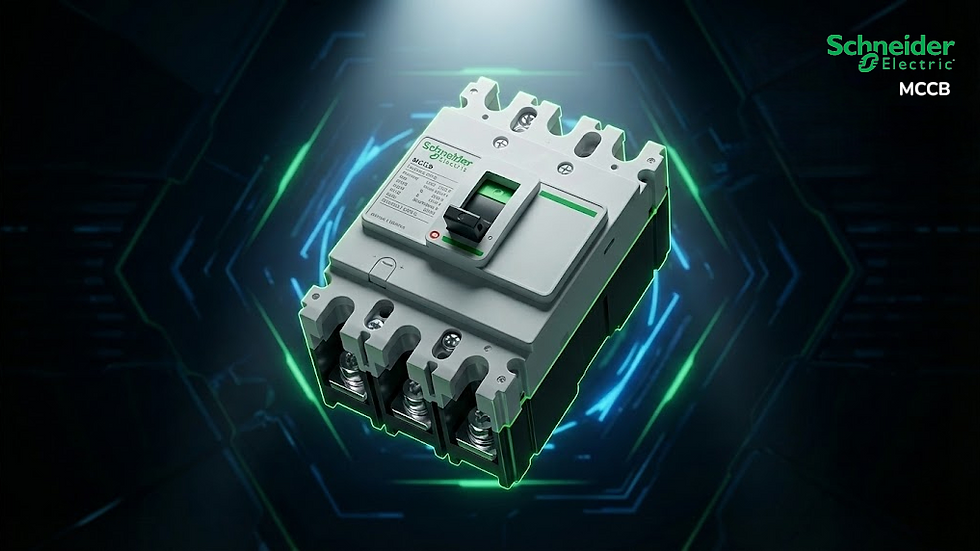
Schneider MCCBs are engineered with a focus on compactness, smart monitoring, and modularity. They are especially popular in commercial buildings, infrastructure projects, IT campuses, and mixed-load industrial applications. Schneider places strong emphasis on precision, digital diagnostics, and ease of installation, making their MCCBs ideal for modern, technology-driven electrical systems.
Overview & Technical Features of Schneider MCCB
Schneider MCCBs offer a blend of protection reliability, space efficiency, and intelligent capabilities. Their Micrologic trip units are well-known for delivering detailed fault analytics and accuracy.
Features & Advantages
Compact, energy-efficient design with precise tripping characteristics.
Wide selection of frame sizes and current ratings.
Easy installation and modularity with other Schneider Electric switchgear products.
Optional communication modules for smart monitoring.
Typical Industrial Applications
Commercial buildings, factories, and industrial parks.
Utilities with medium-voltage distribution requirements.
Renewable energy integration and modern data centers.
Reliability & Innovation
High operational life and consistent performance under variable loads.
Complies with IEC 60947-2 standards.
Focused on energy management and integration with EcoStruxure platform.
Procurement & Availability
Schneider MCCB catalogue provides detailed selection guides.
Transparent Schneider MCCB price list for budgeting and procurement.
Distributed through authorized Schneider MCCB distributors, including India.
For budgeting and tendering exercises, EPC contractors commonly validate selections against the Schneider MCCB price list only after finalizing protection settings and system architecture.
Schneider MCCBs perform well in environments demanding high precision and compact panel designs—such as data centers, airports, corporate campuses, and commercial complexes.
Technical Specification Comparison: Siemens vs Schneider MCCB
Parameter | Siemens MCCB | Schneider MCCB |
Current Rating | 16A – 1600A | 16A – 1600A |
Breaking Capacity | Up to 150 kA | Up to 150 kA |
Trip Units | ETU (advanced diagnostics) | Micrologic (best-in-class energy analytics) |
Mechanical Endurance | 10,000 – 20,000 ops | 20,000 – 25,000 ops |
Electrical Endurance | 3,000 – 8,000 ops | 3,000 – 6,000 ops |
Temperature Stability | Very strong | Strong |
Smart Monitoring | Available | More advanced |
Panel Space Requirement | Larger | More compact |
Siemens MCCB vs Schneider MCCB: Technical Comparison
Comparison Category | Siemens MCCB | Schneider MCCB |
Build & Durability | Rugged external casing and robust internal mechanism designed for heavy industrial endurance | Compact, modular construction optimized for flexible installations |
Breaking Capacity | Excels in very high fault-level industrial environments | Wide range suitable for both commercial and industrial requirements |
Trip Unit Technology | Focuses on stability and reliability under heavy loads (thermal-magnetic & electronic) | Micrologic trip units provide advanced diagnostics, metering, and detailed energy analytics |
Thermal Performance | Highly tolerant of high ambient temperatures and dusty conditions | Performs best in controlled environments with precise monitoring needs |
Space Requirements | May require more panel depth in certain series | Compact design optimized for space-efficient panels |
Smart Connectivity | Available on select models; focuses on reliability | Stronger digital integration with fine-grain monitoring and analytics |
Application Fit | Ideal for heavy industries, high-fault networks, and harsh operating conditions | Best suited for smart buildings, infrastructure, data centers, and mixed-load installations |
Buying Guide: How to Choose the Right MCCB
Choosing the right MCCB is an engineering decision, not a brand decision. The wrong selection leads to nuisance tripping, overheating, or poor fault discrimination.
Evaluate the following factors:
Rated current (In)
Breaking capacity (Ics/Icu) needed based on fault studies
Load type: motor load, resistive load, or mixed
Trip unit requirements: thermal-magnetic vs electronic
Number of poles: 2P, 3P, or 4P
Installation environment: temperature, dust, humidity
Panel space and mounting constraints
Need for energy monitoring or system integration
Compliance with IEC standards
A well-chosen MCCB reduces operational risk, extends equipment life, and ensures better system selectivity.
Why Buy MCCBs from Eleczo?
Eleczo is one of India’s most trusted electrical marketplaces for authentic, industrial-grade MCCBs. For procurement teams, panel builders, EPC contractors, and MEP consultants, Eleczo eliminates the risk of counterfeit products and simplifies the sourcing process.
Eleczo provides:
100% Genuine Siemens & Schneider MCCBs supplied directly through authorized OEM channels
Extensive Product Range covering all current ratings, poles, and breaking capacity levels
Technical Guidance to help buyers select MCCBs based on load, fault current, and operating environment
Bulk Procurement Support with competitive pricing for industrial projects
Pan-India Delivery with fast dispatch and reliable logistics
Dedicated After-Sales Assistance to support installation and documentation needs
One Marketplace for All Electrical Needs including MCBs, ACBs, contactors, switchgear, and industrial components
If your priority is authenticity, reliability, and expert-backed selection, Eleczo provides a procurement advantage unmatched by generic suppliers or offline distributors.
Final Verdict: Choose the MCCB That Fits Your Application
Siemens and Schneider MCCBs are both exceptional, IEC-compliant, globally trusted protection devices. The real difference shows up only when you map their strengths to your operating environment. Siemens typically stands out in demanding industrial setups where circuits experience high fault levels, continuous stress cycles, heat exposure, and heavy mechanical wear. Its design philosophy prioritizes endurance, ruggedness, and fail-safe operation under harsh electrical and physical conditions.
Schneider, on the other hand, excels when precision, intelligence, and compactness matter more than brute strength. Its MCCBs fit perfectly into modern digital electrical infrastructure where space constraints, real-time monitoring, energy insights, and remote management play a major role. In advanced control panels, commercial buildings, and smart distribution systems, Schneider’s technology-driven architecture delivers a clear edge.
At the end of the day, the right choice is dictated by your load characteristics, environment, fault levels, and control requirements—not brand loyalty. Matching the MCCB to the application is the only approach that guarantees long-term reliability and protection.
Whatever your project demands, Eleczo ensures access to genuine, certified, and technically fitting MCCBs from both brands. With expert guidance, accurate specifications, and nationwide availability, Eleczo helps you source the exact protection device your installation needs without compromise.
If your application requires Siemens-grade industrial protection, the following MCCB models are typically used across plants, commercial buildings, and industrial feeders:
Frequently Asked Questions:
Q1. What is the main difference between Siemens MCCB and Schneider MCCB?
The primary difference lies in design philosophy. Siemens MCCBs emphasize ruggedness, high fault tolerance, and mechanical endurance for heavy industrial environments, while Schneider MCCBs focus on compact design, precision trip units, and smart monitoring capabilities for modern installations.
Q2. Which MCCB is better for heavy industrial applications?
For heavy industries with high fault levels, continuous operation, and harsh conditions, Siemens MCCBs are generally preferred due to their higher mechanical durability and thermal stability.
Q3. Are Schneider MCCBs suitable for industrial use?
Yes. Schneider MCCBs are widely used in industrial systems, especially where space optimization, energy monitoring, and digital integration are required, such as data centers, infrastructure projects, and mixed-load facilities.
Q4. How do I choose between Siemens and Schneider MCCB?
The choice should be based on fault current levels, load type, operating environment, panel space, and monitoring requirements, not brand preference. System design and protection coordination are more important than the manufacturer name.
Q5. Do Siemens and Schneider MCCBs comply with IEC standards?
Yes. Both Siemens and Schneider MCCBs comply with IEC 60947-2 standards, ensuring safe operation, reliable fault interruption, and international acceptance for industrial installations.
Q6. Which MCCB offers better breaking capacity?
Both brands offer a wide range of breaking capacities. However, Siemens MCCBs are often selected for very high short-circuit levels, while Schneider MCCBs provide sufficient breaking capacity for most commercial and industrial applications.
Q7. Are electronic trip units available in both Siemens and Schneider MCCBs?
Yes. Both manufacturers offer thermal-magnetic and electronic trip units. Schneider’s Micrologic trip units are known for advanced diagnostics, while Siemens offers reliable electronic protection with select communication-ready models.
Q8. Which MCCB is easier to install and maintain?
Schneider MCCBs are generally easier to install due to their compact and modular design. Siemens MCCBs may require more panel space but often compensate with longer service life and reduced maintenance frequency.
Q9. Where can I find the Siemens and Schneider MCCB price list?
The Siemens MCCB price list and Schneider MCCB price list can be accessed through authorized distributors and trusted electrical marketplaces like Eleczo, where pricing aligns with genuine product specifications, ratings, and industrial requirements.
Q10. Why should I buy Siemens or Schneider MCCBs from Eleczo?
Eleczo ensures 100% genuine Siemens and Schneider MCCBs sourced through authorized channels, with expert technical support, competitive pricing, and pan-India delivery, reducing procurement risk for industrial buyers.


Comments